
Painted Stone Site: Introduction
Machine translation from the original, not yet reviewed by the author.
Original in Spanish
Love at First Sight
Publishing the photographs of the Polanco Site in the newspaper La Prensa led many people to tell me about petroglyphs they knew. For example, one night I went to pick up my girlfriend at a friend’s house; the lady of the house—who had seen my photos in the paper—showed me a newspaper clipping from 1998 that spoke of the petroglyphs in Calderas (Boquete). The article carried a photograph of a stone riddled with very strange drawings; one of them struck me forcefully from the first instant—it is the one I show below.
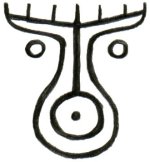
My heart raced when I saw it. I called my girlfriend (who is now my wife) and showed her the drawing with a smile: “I only need it to be pointing East,” I told her. She did not understand, so I explained to her: “If this drawing is pointing East or West, then it is a calendar, but not of rains: one to mark the equinoxes and solstices. These are the months…” And I explained it to her. Her face lit up with joy. Since the article did not indicate the orientation of the drawings, I decided to visit the site in person to verify whether they pointed where I believed.
On March 13, 2000, I took 6 photographs of the Los Olivos stone, and saved 7 exposures from the roll of 13 for the Calderas stone.
The Visit
My girlfriend’s parents live near the site, in David, so on March 18 we went with my father and a friend to visit it. While we were traveling in the car, I told my father that I would measure the angle between the central line of the drawing and its ends, to see whether it came close to 23.4°, which is the angle between the points where the Sun stands on the horizon at the solstice and at the equinox. When I arrived at the stone, I got a great surprise…
I discovered that the calendar had two small circles at its sides, which did not appear in the newspaper image. I understood then that the function of these circles was to indicate the angle that I sensed was included in the calendar, so I decided to measure the angle between the central line and one of the side circles (the left one). The angle turned out to be 23.2°, much closer than I expected. At that moment, every doubt about the purpose of that drawing vanished from my mind: it was, definitively, a calendar of solstices and equinoxes.
I invite the reader to make their own hypothesis.
Notes
Next page: Geographic Location