
Polanco Site: The Stone
Machine translation from the original, not yet reviewed by the author.
Original in Spanish
Fertile area at the foot of the stone
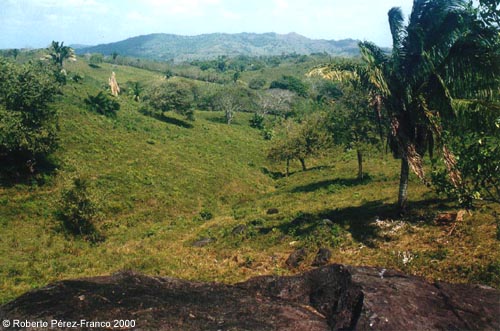
At the foot of the stone, to the North, there is a piece of land furrowed by a few creeks. In the rainy season, the water that falls on the hills must run down the slopes, converging on this land. This land must be excellent for agriculture.
The East face of the stone
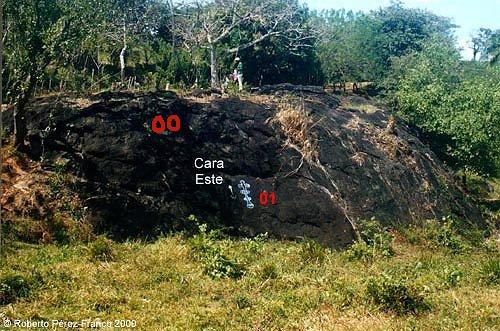
On the East face there are two drawings (00 and 01). Both drawings are pointing directly West. The photograph, taken in 2000, shows drawing 01 painted with chalk for better contrast in the photograph. Drawing 00 was discovered on the third visit, in 2002, and therefore was not chalked in 2000 and does not appear in this photograph.
The North face of the stone
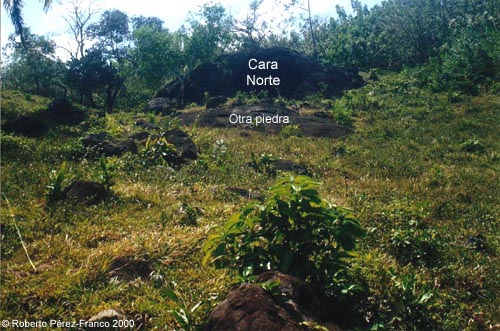
Note that at the foot of the stone there is another large stone, level with the ground.
The North face is very flat. It is striking that there is no drawing on it, even though it is the flattest. This tells us that the face chosen to receive the drawings is not necessarily chosen based on whether it is flat or not.
The North and West faces of the stone
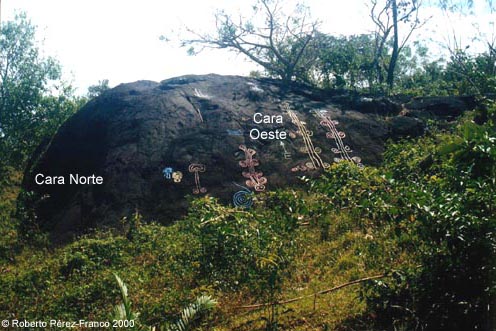
As can be seen in the photograph above these lines, there are many drawings on the West face and none on the North face. These drawings were marked with chalk for better contrast in the photograph.
The West face of the stone
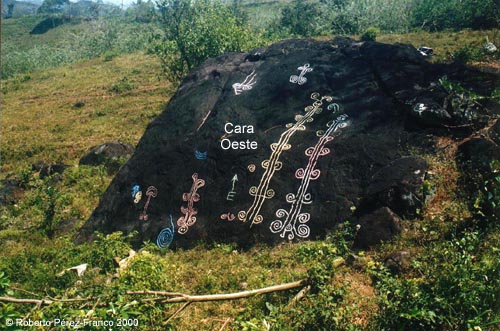
There are 13 drawings on the West face, some more complex than others. The drawings will be examined in the next section. Below I show the numbering I have given to the drawings. The numbering starts at 02 because drawings 00 and 01 are on the East face.
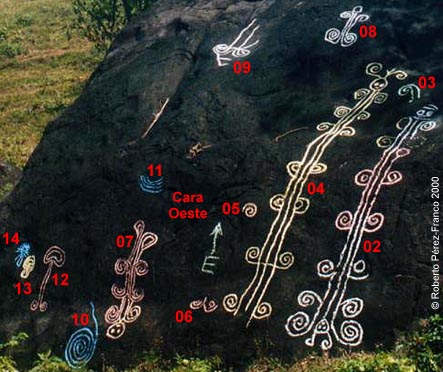
Notes:
I believe drawings 02 and 03 are a group: drawing 03, in my view, was an attempt at an antenna for drawing 02.
I believe drawings 05 and 06 used to be a single drawing of the type of 07, but a piece of the stone breaking off fragmented it.
I believe drawing 11 used to be like 10, but a piece of the stone breaking off fragmented it.
Drawings 02, 04, 07, 08, 09 and 12 are aligned toward the East (the arrow with the letter E marks the direction of the East on the stone).
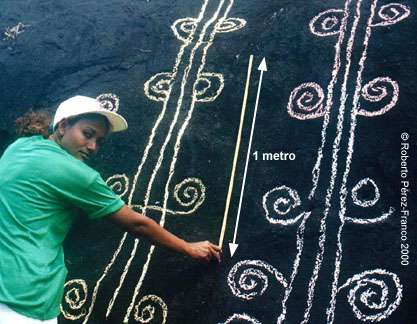
To give a sense of the scale of the drawings, Cristina Torres, my friend from Capira, holds up for the camera a tape measure extended exactly to the length of one meter, next to drawings 02 and 04.
Notes
Note: As some specialists informed me later, chalking petroglyphs is not a recommended practice in some cases. For that reason, I ask visitors to the stone not to mark the carvings with chalk, paint or any other substance.
Next page: All the drawings, one by one