
Polanco Site: The Rain Calendar
Machine translation from the original, not yet reviewed by the author.
Original in Spanish
My Hypothesis on Drawing 04 at Polanco
The drawings on the Polanco stone are, without a doubt, works of art and a heritage of our country. A heritage that, ignored, sleeps in the shade of the indifference of institutions that ought to make its existence known and study its meaning.
I present here my personal hypothesis on the rain calendar of the Polanco stone. It was born one early morning in 1996, after a few minutes of observation at the stone and as many more of analysis on the bus back. Now, almost four years later, I ratify it and present theoretical and visual material to support it. I do not claim that it is the truth, but it is an explanation so simple and beautiful that it is interesting to know it.
In studying the Polanco site, my intention is not to impose my ideas, but to reveal to Panamanians a piece of their heritage that they do not know, and in passing to contribute my answers to the following questions:
Who made the drawings? I believe these drawings were made by pre-Columbian Panamanian Indians living in the Capira area.
When? I believe the drawings must be pre-Hispanic, but I cannot give an exact date.
For what purpose? Drawing 04 is, in my opinion, a calendar to remember the rainfall pattern in the region, for agricultural purposes. Other drawings, such as 01, 02-03, 05-06, 07 and 08 could also be calendars; in the case of 02-03, this calendar would be lunar (possibly a failed attempt to arrive at model 04).
Next, I support the rain calendar hypothesis.
Drawing 04

The drawing consists of a kind of “caterpillar.” At the upper end it has a head with two asymmetrical antennae, eyes and mouth. In the middle stretch it has a body made up of three lines. These three lines, about three meters long, point toward the East. There are six pairs of projections on the sides of the body, of three different types.1 At the lower end it has a root, separated from the body by a horizontal line, the only one in the entire drawing.
The Meaning of the Three Parts
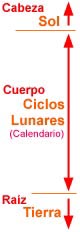

The head is at the eastern end of the drawing, pointing toward the rising sun. For that reason, the head represents the Sun, which is in the sky and rises in the East.
At the opposite end is the root, representing the Earth, the ground.
Joining sky and earth is the body, which has six pairs of circular projections. These projections represent the Moon and the lunar cycles of the year. It is in these cycles that we find the calendar.
The Projections
The twelve projections on the body represent the twelve lunar cycles in the year.
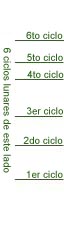
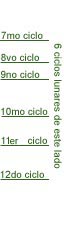
Let us start at the lower left end of the body, and number the cycles from bottom to top, and then, passing through the upper end, from top to bottom until ending at the lower right end of the body. The numbering comes out as shown in the figure beside.
This distribution shows that there are six lunar cycles while the sun rises to the left of East, and another six while the sun rises to the right of East, until a year is completed. This is astronomically correct.
Equinoxes and Solstices in the Calendar
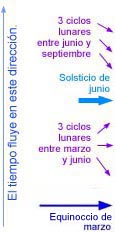
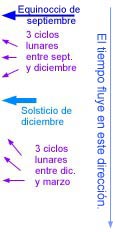
The ends and the center of the figure are key points for following the lunar months in the calendar, since they help us locate the solstices and equinoxes. The head is one extreme point. The root, set off from the body by the horizontal line, is the other. The center of the body shows a space between projections that is more pronounced than the rest of the spaces.
The root, as its very idea suggests, must serve as the beginning. The root indicates the March Equinox, in which the Sun passes through the East (toward which the body points) from right to left.
Between this point and the next there are three lunar cycles.
The large space in the center, on the left side, represents the June solstice, in which the Sun stops its march to the left and turns back on its steps, traveling to the right.
Between this point and the next there are three lunar cycles.
Symbol of the Sun, the head serves to indicate the September Equinox, in which the Sun again crosses the East traveling from left to right.
Between this point and the next there are three lunar cycles.
The large space in the center, on the right side, represents the December solstice, in which the Sun stops its march to the right and turns back on its steps, traveling to the left.
Between this point and the next there are three lunar cycles. The cycle repeats once more, starting at the root.
The Calendar and the Sun
I am aware that the general population is not familiar with the movement of the Sun during the year, so I have made some diagrams that show this dynamic. To the right of each month I show a sketch of how this movement is recorded in the Polanco calendar. Note that the diagrams are made around the 21st of each month. The red dots on the calendar mark a 30-day cycle that begins on the day shown in the astronomical diagram and ends just when the next cycle begins.
























Diagrams generated in Starry Night Basic.
Civil Calendar and Astronomical Points
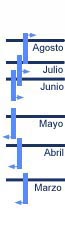
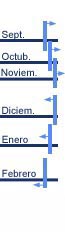


Our civil year begins on January 1. The year of the Polanco calendar begins with the Equinox of about March 21. Our civil months, therefore, do not coincide with the lunar months or cycles of the Polanco calendar. Above these lines I show a diagram explaining this relationship. The light-blue arrows indicate the direction in which the sun is moving at that moment. The light-blue vertical lines indicate the approximate beginning and end of the civil month of our current calendars. The blue horizontal lines indicate the astronomical points at which events such as the solstices and the equinoxes occur. Between two of these points there is a lunar cycle (approx.). Every third one of these points is a solstice or equinox (approx.).
As we can see, the beginning of our civil month does not coincide with the astronomical points, but the one-to-one relationship, obviously, is maintained, allowing us to understand this calendar easily.
So far we have seen that drawing 04 of the Polanco stone is a calendar that has twelve lunar cycles to a year, and that begins at the March Equinox. Now, if the only purpose of the calendar was to number the cycles, it would have been enough to use spirals of the same type on all the projections. On the contrary, the calendar shows three different types of projections. What meaning do these projections have? Does this calendar have another purpose besides numbering the cycles?
The Meaning of the Projections: Rainfall During the Month
I still remember my Science classes in elementary school. The water cycle was one of my fascinations. Water evaporates from damp earth, from rivers and seas, and rises to the sky. There, in the sky, it condenses and falls again to the earth. It could be said, in general terms, that during the dry months, more water evaporates than falls as rain. During the rainy months it is the opposite, since more falls as rain than evaporates. While in the semi-dry (or semi-rainy) months, evaporation and rain occur in similar proportions. How could this difference between rainy, dry and semi-dry months be represented in the projections of a drawing on a stone? Below these lines is the answer.

The dry months are represented in the calendar with spirals that curve upward, indicating that water rises from the earth to the sky.

The semi-dry months are represented with a handle, indicating that water rises and falls at the same time, in balance.

The rainy months are represented with spirals that curve downward, indicating that water falls from the sky to the earth.
Joining the Two Concepts: The Rain Calendar


If we join the names of the months that correspond to the projections with the meaning of their shapes, we have the rain calendar of the Polanco stone. Above these lines I show the complete diagram of the calendar. This calendar tells us that the rainiest months are those between May and December, while the dry months are those between January and April.
The archaeologist John Griggs of the Smithsonian Tropical Research Institute, who visited the site of the stone with me, told me that certain studies indicate that the climate of the Isthmus of Panama has not changed greatly in the last five thousand years.
Those of us who have lived on the Pacific slope of Panama know that the months this calendar indicates as rainy are, indeed, the rainy months of our region of the interior. Likewise, the dry and semi-dry months correspond to those we know from experience as such in our region.
For those who do not know the climate of Panama personally, here are some documents that describe it:
In the document “Comportamiento de las lluvias en el Istmo de Panamá” (Behavior of the Rains in the Isthmus of Panama) (see) of the Hydrometeorology and Studies Management of ETESA (see), we verify that the rainfall pattern of the Pacific basin (where the Polanco Stone is located) is as the calendar describes it:
The seasonal migration of the tropical air masses of the Pacific and the subtropical air masses of the Atlantic that accompany the sun in its annual course constitutes the dominant control over precipitation patterns in Panama. These migrations, in combination with the local orography, establish well-defined precipitation regimes.
On the Pacific slope there is a single, extended rainy season that begins in late April or early May and persists until mid or late November; in some areas of the mountain range the season lasts longer. This period is characterized by the precipitation maxima coinciding with the passage of the ITCZ over Panama heading north (June) and heading south (October) in its displacement following the sun in its annual course.
Between December and the end of April the dry season2 sets in on this slope, with an almost total absence of rain. Sometimes, in this period, storms and copious rains occur, caused by incursions of intense cold fronts that manage to reach our latitudes and that are pushed by vigorous advances of enormous masses of polar air, coming from the frozen Arctic regions.
In addition, in the CIA’s “World Factbook” (see), we find that the climate of Panama is “tropical maritime; hot, humid, cloudy; prolonged rainy season (May to January), short dry season (January to May)”. That is: the climate of Panama is tropical maritime; hot, humid, cloudy; prolonged rainy season (between May and January), short dry season (between January and May).
Thus we verify that the rainy season and the dry season coincide with the period indicated by drawing 04 of the Polanco stone, reinforcing our hypothesis that this drawing is in fact a solar rain calendar, which may have served the pre-Columbian Indians to calculate the time for planting and harvest.
Notes
- There are seven pairs in all: the seventh is below the horizontal line, in the root. ↩
- The Spanish original says verano (summer), which in Panama means the dry season, from December to April. ↩
Source: Hydrometeorology and Studies Management of ETESA