
Los Olivos Site: The Drawings, One by One
Machine translation from the original, not yet reviewed by the author.
Original in Spanish
It is my opinion that these drawings were made by pre-Columbian Indians, possibly from the same period as the inhabitants of Cerro Juan Díaz who made the piece of jewelry that we mention further on. However, I have no proof to demonstrate it, nor is there certainty or consensus on this subject. The persistence of the spirals makes me think of the possibility that the same human group that carved the petroglyphs of Los Olivos also carved those of Painted Stone and Polanco. Likewise, a piece of jewelry found at Cerro Juan Díaz shows the same shape of two spirals connected to each other that we see on this stone. However, the spiral figure is very common and appears frequently in different cultures, so it is difficult to draw definitive conclusions from this similarity.
01
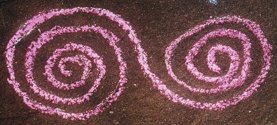
Description of 01: This drawing consists of two large spirals connected by an S.
My personal opinion on 01: This drawing is one of the most beautiful spirals I have seen among Panamanian petroglyphs. It bears a great resemblance to a gold piece found at the Cerro Juan Díaz site. Note that the Cerro Juan Díaz site and the Los Olivos site are less than 15 kilometers apart.
02
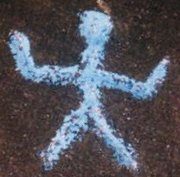
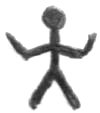
Description of 02: This drawing consists of a ‘star’ with two straight lines, two broken lines and one with a bulbous end.
My personal opinion on 02: It is almost impossible not to notice that this drawing represents a man. It is identical to the drawings that children make in school. It may be a man in general; it is less likely that it represents a warrior, a leader or another prominent member of the community. This type of figurine, as Luz Graciela Joly informs me, is called an “adorant” and is common in Panamanian petroglyphs.
03
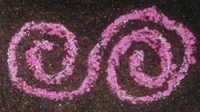
Description of 03: This drawing consists of two small spirals joined by an S.
My personal opinion on 03: I believe this drawing represents the same thing as 01, but on another scale.
04
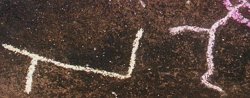
Description of 04: This drawing consists of two sets of broken lines.
My personal opinion on 04: I believe this drawing represents a small map, probably of a stretch of the river and/or of roads that the community used. There is a record that some petroglyphs in the province of Chiriquí are maps, describing rivers, springs and the Barú volcano with impressive accuracy.
05
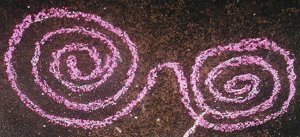
Description of 05: This drawing consists of two large spirals joined by a U.
My personal opinion on 05: This drawing, undoubtedly related to 01 and 03, presents an innovation: the link between the spirals is not in the same direction (S) but in the opposite one (U). It is a beautiful piece of work, a lovely example of rock art. It might perhaps represent hills near the river.
06
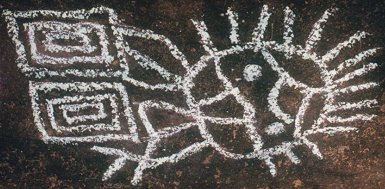
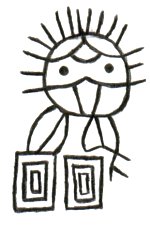
Description of 06: This drawing, enigmatic and complex, consists of two sets of concentric squares, a large circle and many additional lines. Note the symmetry of the ‘face’ in the lines that surround the large circle.
My personal opinion on 06: This drawing has a kind of face. And in this face, the arrangement of the mouth area brings to my mind that of a bird. Likewise, below the face, the lines look like folded wings. For this reason, I think this drawing may represent an owl. It could also be a human face decorated with lines, in the manner of some Panamanian Indians. Probably the lines indicate the power of the person. A shaman, perhaps, in the middle of a rite or ceremony.