
Painted Stone Site: Explanation of the Calendar
Machine translation from the original, not yet reviewed by the author.
Original in Spanish
The calendar on the stone
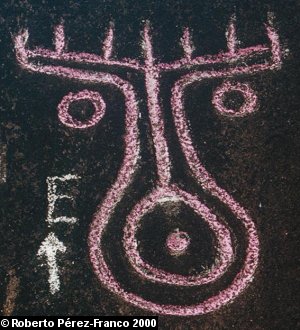
The photograph above these lines shows the Calderas calendar, carved on the surface of the ‘Painted Stone.’ The photo was not taken directly facing the calendar, and for that reason it looks somewhat tilted to the left.
Equinoxes and solstices in the calendar
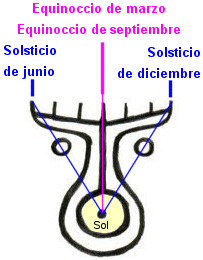
The large circle below (marked in yellow) represents the Sun, indicating that this is a solar calendar.
The central line indicates both equinoxes: the one in March and the one in September, when the Sun passes through the East.
The end on the left side represents the June solstice, when the Sun stops its march to the left and retraces its steps, traveling to the right.
The end on the right side represents the December solstice, when the Sun stops its march to the right and retraces its steps, traveling to the left.
Dates and lunar cycles (months) in the calendar
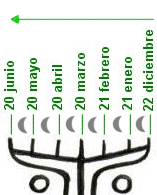
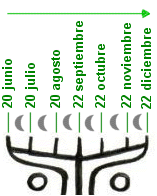
In the drawings above these lines, I have marked two things:
The first is the dates that the lines indicate. The equivalents of these dates in our civil calendar are determined, obviously, by the dates of the solstices and equinoxes in our civil calendar.
The second is the lunar cycles, indicated by small gray moons. As we see in the diagram, between every two lines there is one lunar cycle. And between any equinox and any solstice there are three lunar cycles, indicated by three lines.
The calendar in action
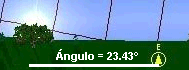
As I did with the Polanco calendar, below I show a sequence of the movement of the sun in the sky accompanied by marks on the calendar, to show how it really works.



















Diagrams generated in Starry Night Basic.
One more proof: the angle

The magenta point indicates the equinox. The red point indicates the solstice. The blue point, the origin (the Sun). Let us measure the legs…
Here is one more proof that the Calderas petroglyph is a calendar of solstices and equinoxes:

The green line measured 31.5 cm. The blue line measured 13.5 cm. With tan-1(13.5/31.5) we obtain 23.2°!
The angle marked on the calendar by the left side circle (23°) and the angle the Sun makes with the East at the June solstice (23°) are equal.

Notes
Note: I have taken the dates of the solstices and equinoxes of the year 2000, by way of illustration.